Thin & Chewy Cookies
One master dough. Thin, rippled, bendy — and four ways to flavour it.
Prep 15 min · Bake 11 min · 180 °C top/bottom heat · Base 15 cookies
v2.1 · StableAttempt log (3)
- v2.1 — Tested — sift the sugar2026-10-24 · Stable
Baked and confirmed: thin, rippled and chewy, no more testing needed. One addition: sift the brown sugar before whisking — its clumps never dissolve in the butter and stay as hard sugar spots in the cookie.
No ingredient changes. - v2.0 — No honey, no special sugar2026-10-22 · Archived
Honey out: even a teaspoon leaves a floral note under the vanilla and cinnamon, and nobody should buy invert syrup for 5 grams. Shifted 15 g from white to soft brown sugar for the same moisture and chew, and added 5 g neutral oil for day-two softness.
Neutral oil (rapeseed or sunflower): +5 gSoft brown sugar, packed: 160 g → 175 g (+15 g)White sugar: 100 g → 85 g (−15 g)Honey: 7 g - v1.0 — Honey draft2026-10-22 · Archived
First draft: 160 g brown and 100 g white sugar plus a teaspoon of honey as an invert-sugar booster for chew.
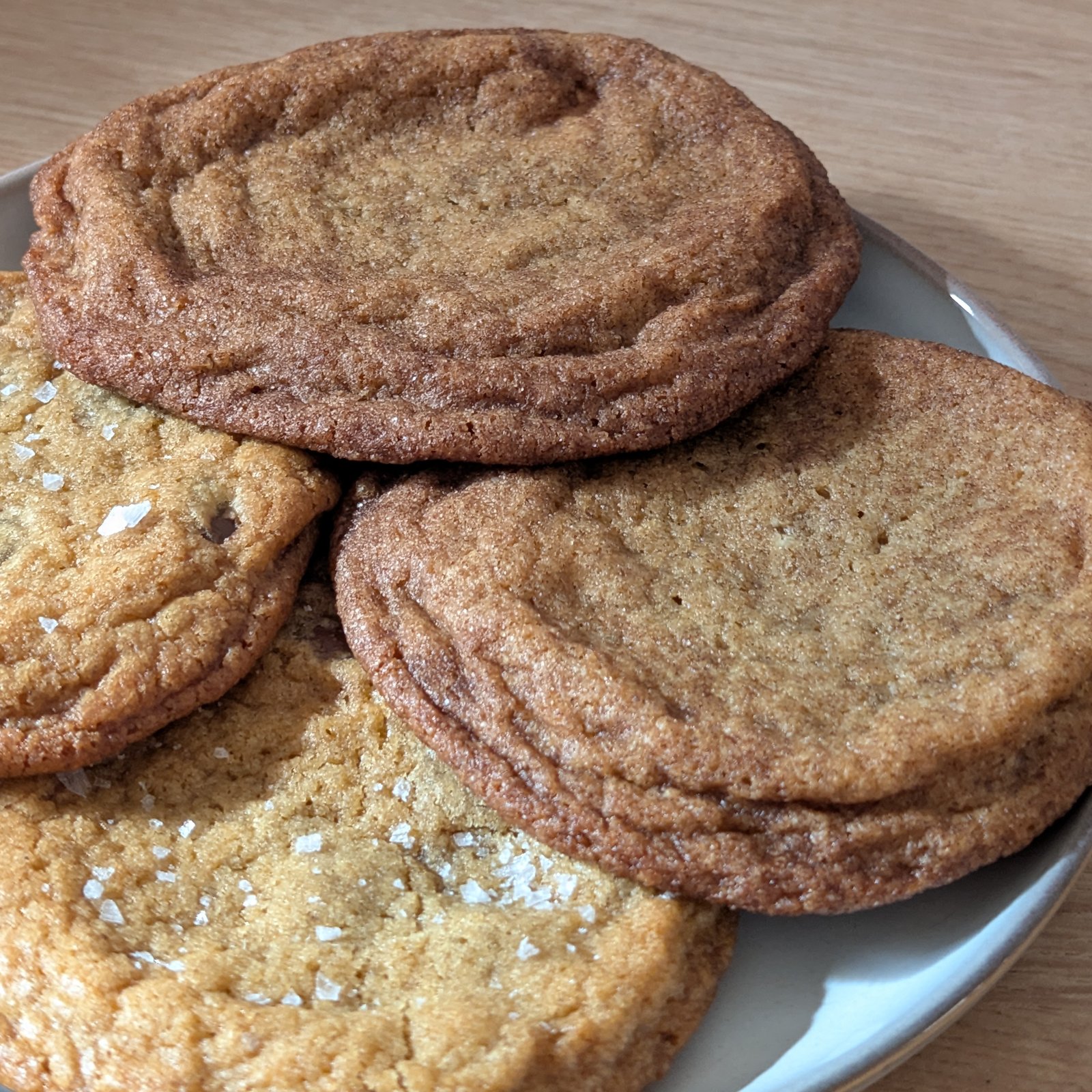
Built to copy the texture of a supermarket snickerdoodle dough I'm currently obsessed with: wide, thin and chewy instead of cakey. Melted butter plus an extra yolk spreads flat instead of trapping air. Lots of soft brown sugar keeps it fudgy for days. Baking soda weakens the gluten so it spreads and browns; a little baking powder lifts the surface just enough to crackle before it collapses.
- + No mixer
- + Pan-bang ripples
Method
- 1
Fats and sugars, by hand
Sift the brown sugar first — its clumps never dissolve once they hit the butter. Whisk the warm melted butter, oil, brown sugar, white sugar and vanilla sugar by hand for about 1 minute until glossy and lump-free. No stand mixer on high: whipped air makes cakey cookies.
Sift the brown sugar first — its clumps never dissolve once they hit the butter. Whisk the warm melted butter, oil, brown sugar, white sugar and vanilla sugar by hand for about 1 minute until glossy and lump-free. No stand mixer on high: whipped air makes cakey cookies.
Brown the butter in a saucepan until it smells nutty and shows golden specks, stir in 15 g water or milk to replace what evaporated, and let it cool to warm. Sift the brown sugar — its clumps never dissolve once they hit the butter. Then whisk the butter by hand with the oil, brown sugar, white sugar and vanilla sugar for about 1 minute until glossy and lump-free.
Sift the brown sugar first — its clumps never dissolve once they hit the butter. Whisk the warm melted butter, oil, brown sugar, white sugar and vanilla sugar by hand for about 1 minute until glossy and lump-free. No stand mixer on high: whipped air makes cakey cookies.
- 2
Emulsify the eggs
Add the egg, the extra yolk and the vanilla extract. Whisk hard for 30–45 seconds until pale and thick like caramel. Dissolving the sugar a little here gives the shiny, crackled top.
- 3
Fold in the dry mix
Whisk the flour, baking soda, baking powder and salt in a separate bowl. Fold them into the wet mix with a spatula until just combined — stop while a few flour streaks remain.
- 4
Flavour
Fold in the 180 g chopped dark chocolate until just evenly distributed.
Fold in the 120 g white chocolate and 1.5 g cinnamon until just evenly distributed. If you use the optional 1.5 g cream of tartar, whisk it into the dry mix in step 3.
Fold in the 100 g chocolate chunks and 70 g chopped toffee until just evenly distributed.
Fold in the 100 g white chocolate, 65 g pistachios and 1 g cardamom. Keep a few pistachio pieces and chocolate chunks back to press onto each ball so they show after spreading.
- 5
Chill and portion
Cover and chill for 30–45 minutes until scoopable, like play dough. Roll balls of 50 g each — the plain dough makes 15, mix-ins give you a few more.
Cover and chill for 30–45 minutes until scoopable, like play dough. Roll balls of 50 g each — the plain dough makes 15, mix-ins give you a few more. Mix 40 g sugar with 4 g cinnamon and roll every ball generously in it.
Cover and chill for 30–45 minutes until scoopable, like play dough. Roll balls of 50 g each — the plain dough makes 15, mix-ins give you a few more.
Cover and chill for 30–45 minutes until scoopable, like play dough. Roll balls of 50 g each — the plain dough makes 15, mix-ins give you a few more.
- 6
Bake and bang the pan
Preheat to 180 °C top/bottom heat. At most 6 balls per parchment-lined sheet, at least 8 cm apart — they spread a lot. Bake one sheet at a time for 10–12 minutes. For ripples: at minute 9, lift the sheet about 5 cm and drop it flat, then bake the last 1–2 minutes. Pull them while the centres still look pale and soft.
- 7
Let them set on the sheet
Press a pinch of flaky salt onto each cookie straight out of the oven. Leave them on the hot sheet for 5–8 minutes — they set and flatten into fudgy discs — then move them to a rack. Make-ahead: freeze the rolled balls and bake straight from frozen at the same temperature, 1–2 minutes longer.
Leave the cookies on the hot sheet for 5–8 minutes — they set and flatten into fudgy discs — then move them to a rack. Make-ahead: freeze the rolled balls and bake straight from frozen at the same temperature, 1–2 minutes longer.
Leave the cookies on the hot sheet for 5–8 minutes — they set and flatten into fudgy discs — then move them to a rack. Make-ahead: freeze the rolled balls and bake straight from frozen at the same temperature, 1–2 minutes longer.
Leave the cookies on the hot sheet for 5–8 minutes — they set and flatten into fudgy discs — then move them to a rack. Make-ahead: freeze the rolled balls and bake straight from frozen at the same temperature, 1–2 minutes longer.